
Do I Need Planning Permission for a Swimming Pool?

What is permitted development and how does it apply to swimming pools?
Permitted development rights allow certain types of building work to proceed without a formal planning application.
Swimming pools fall under Class E of the General Permitted Development Order, which covers buildings, enclosures, pools and containers incidental to the enjoyment of a dwelling.
In practical terms, this means most outdoor domestic swimming pools can be built without applying for planning permission, provided the project stays within a set of clearly defined limits.
Key conditions for permitted development
The pool and all other outbuildings, extensions and structures must not cover more than 50 percent of the total curtilage (garden and surrounding land) of the property, excluding the original house footprint
The pool must not be positioned forward of the principal elevation (the front of the house facing a highway)
If a pool hall or enclosure is built, it must be single storey with a maximum eaves height of 2.5 metres, and a maximum overall height of 4 metres for a dual-pitched roof or 3 metres for any other roof type
Any structure within 2 metres of a boundary must not exceed 2.5 metres in height
No verandas, balconies or raised platforms above 0.3 metres are permitted as part of the development
These conditions apply to the pool and any associated structures such as plant rooms, pool houses or decking. It is important to calculate the cumulative footprint of all outbuildings, not just the pool alone.
Coordination with architects, quantity surveyors and contractors - how CSPAS works

There are several scenarios where permitted development rights do not apply and a formal planning application is necessary.
Listed buildings
If your property is a listed building, you will almost certainly need planning permission and potentially listed building consent for any pool installation, whether indoor or outdoor.
The requirement applies to the building and its curtilage, so a pool anywhere within the grounds will typically trigger a full application.
This does not mean a pool cannot be built. It means the design, location and materials will need to satisfy the local planning authority's conservation requirements.
Conservation areas
In a conservation area, permitted development rights for pools are restricted. A pool must not be positioned on land between the side elevation of the house and the boundary.
Pools to the rear of the property are generally acceptable under permitted development, but side positions require a planning application.
Pools that exceed permitted development limits
If the pool, together with existing outbuildings, would exceed 50 percent site coverage, or if the design involves structures that breach height limits, a planning application is required. This is more common on properties with existing extensions, garages and garden buildings where the cumulative footprint is already close to the threshold.
A practical guide to permitted development, building regulations and what to check before you build
One of the most common questions homeowners and design teams ask before committing to a pool project is whether planning permission is required. The short answer is that most outdoor swimming pools in England fall within permitted development rights and do not need a formal planning application. But that is not the full picture.
Indoor pools, pools within the grounds of listed buildings, properties in conservation areas and projects involving pool halls or wellness buildings all introduce additional requirements. Building regulations apply separately and are frequently misunderstood.
CSPAS has over two decades of experience delivering bespoke pool and wellness projects across Cheshire and the North West, working alongside architects, developers and high-net-worth homeowners.


Do indoor swimming pools need planning permission?
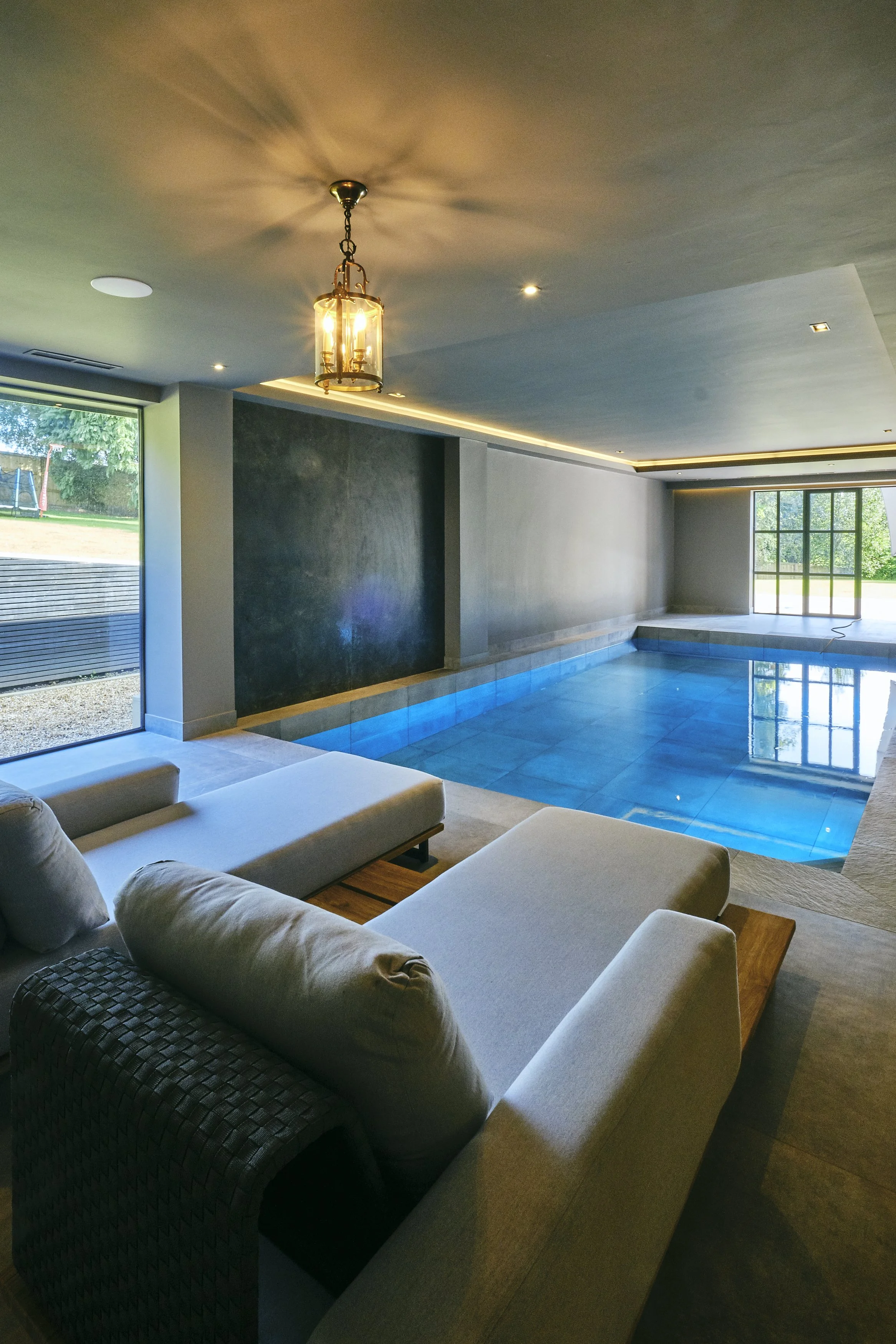
Indoor pools introduce a different set of considerations. If the pool is housed within a new outbuilding (commonly referred to as a pool hall), that building is treated as an outbuilding under Class E and is subject to the same permitted development conditions as any other garden structure. The 50 percent coverage rule, height limits and boundary setbacks all apply.
If the pool is being incorporated into a new extension to the house, it must comply with the permitted development rules for extensions (Class A), which have their own depth, height and boundary restrictions.
Where the pool forms part of a new build, the pool is included in the overall planning application for the property and does not require a separate consent.
Basement and subterranean pools are increasingly popular in high-end residential projects across Cheshire. These require careful consideration.
Excavation for a basement pool is generally treated as ancillary to the permitted development right for the pool itself, but local authorities may take a different view depending on the scale and impact of the works. Professional advice is recommended for any below-ground installation.
Practical steps before starting a pool project

Check your permitted development status
Confirm that your property has not had its permitted development rights removed by an Article 4 direction, a condition on a previous planning permission, or any restrictive covenant on the land. Your local planning authority can confirm this.
Calculate cumulative site coverage
Measure the total footprint of all existing outbuildings, extensions and structures. Add the proposed pool and any associated buildings (plant room, pool house, decking above 0.3 metres). The total must not exceed 50 percent of the curtilage area.
Review designation constraints
Establish whether your property is listed, in a conservation area, National Park, AONB, World Heritage Site or Green Belt. Each designation changes the rules and may require a full planning application.
Engage a specialist pool contractor early
The most common source of avoidable cost and delay on pool projects is late involvement of the pool specialist.
Structural allowances, plant room space, ventilation routes, drainage strategy and waterproofing all need to be resolved at concept stage, not after the main build is underway.
CSPAS works alongside architects and structural engineers from the earliest design stages. This ensures the pool is fully coordinated with the building envelope, services strategy and landscape plan, and that all regulatory requirements are addressed before construction begins.
Confirm building regulations requirements
For indoor pools, engage building control early to agree the insulation strategy, ventilation specification and structural approach. For outdoor pools, confirm electrical and drainage compliance.
About CSPAS
With over two decades of hands-on experience, CSPAS has worked on a broad range of luxury residential projects, including new builds, major refurbishments and full wellness suite installations.
As an award-winning, family-run business, CSPAS is trusted by architects, landscape designers, developers and high-net-worth homeowners for both bespoke concrete pools and premium RivieraPool one-piece installations.
The team provides full plant and filtration design, specialist environmental control for indoor pools and complete wellness solutions including saunas, steam rooms and hydrotherapy features. CSPAS also delivers comprehensive refurbishment and maintenance services for existing pools requiring modern upgrades or technical improvements.
Chris Jenkins, Managing Director of CSPAS, comments;
"Bespoke swimming pool design is about far more than aesthetics. Every project demands precise engineering, coordinated planning and a deep understanding of how the pool will interact with the building and the client’s lifestyle.
Our role is to guide design teams through these decisions early, remove complexity and deliver a pool that performs exactly as it should for years to come."
